
I have been reading loads lately about technology and the problem of hylomorphism, that is the idea that we conceive of an abstract design in our mind which we then create using a passive material that we manipulate to our whims. There is a host of quite fascinating literature on this topic, and I –personally – find most interesting the criticism of this idea. From an academic point of view the arguments against hylomorphism are compelling (e.g. various works by Gilbert Simondon ; and Tim Ingold ), but I also happened to have a ‘practical’ experience which convinced me of this even more.
Even though I am a student (and lover) of art, I hold no pretentions of being an artist. But I do like to keep my hands busy, I find it good for the soul and ever since I remember myself I always liked drawing, doodling, just holding a pen. I have never had any formal training and the most generous definition of my efforts would be ‘amateurish’. What is also interesting for the debate about hylomorphism is that, not being either that talented or independently creative, I have always liked having a subject to inspire me, by which I mean, I would rather look at a picture and try to paint it, be it a live landscape or a photo. And then it really struck me: this is a classic case of hylomorphism: I conceive (or copy) a specific design in my mind and then try and render it on paper. Only that it is also a classic case of how this does not work, ever. No matter how clear the ‘idea’ is in my mind, sharp and well visualised in its structure, its colours, its texture and composition, it never comes out like that. Now, it could easily be argued that this is because I am no Cezanne (although, he was totally averse to the idea of ‘photographic’ painting), but recently I went to a workshop, where we all had to paint the same flower wreath. Of course, having the same design to work with does not mean that we should all make the same thing, but it struck me, that that the reason why we didn’t is not that we are all different persons (although of course we are) but that this is not the way creativity works. The ways the materials responded to each of us were as versatile as the ways we each engaged with the materials in front of us.
And this was made even more apparent to me when I remembered an impromptu clay-working experience I had with the kids during a holiday in Cornwall. I say clay-working because no firing was involved, only clay sculpting. During a walk in the woods we came upon a stream with a lovely clay bed visible on its flank.  We each made a little structure using the clay and anything else we could find around us, leaves, pebbles, twigs. I realise now how organically my ‘design’ developed, without preconceptions, just guided by the materiality of the clay and my desire to make something. Although we might have had a mental template (i.e. let’s build a ‘house’), the way we each engaged with the materials led to the emergence of completely new forms which were linked to completely new mental categories (a ‘fairy cave’; a ‘troll shop”).
 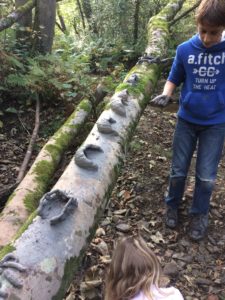 In a way, we still made use of a preconceived design but just not in the proscribed way that technological approaches advocate.
I ‘ve learnt loads about creativity, materiality and technology through this experience. No doubt, the outcome of my efforts was, at some sub-conscious level, influenced by my academic training and my readings on technology and material culture, but the whole practical experience brought home the realness and richness of the embodied engagement, which we surely misplace when we discuss (ancient and modern) technics through rigid classifications. It also made me realise that we perhaps need different ways of writing about and communicating about these issues, but this will be another blog.