
 The joy that is MSCA has a really healthy research budget which means that it is possible to go to conferences again, and even venture a little further afield than usual. For this first foray of House Poetics into the conference circuit, I decided to present an ethnographic aspect of the project at the Society for Historical Archaeology Annual Conference, (Landscapes, Entrepôts, and Global Currents, New Orleans, USA, 3-7 January 2018) ; partly because the archaeological component is still in the process of gathering data and does not have many results to present at this stage; and partly because I was interested in finding out how colleagues working in completely different regions and periods deal with similar research questions, such as those addressed in House Poetics.
Some of these questions involve understanding the new role archaeology is (or should be) playing within the local communities. The call for more symmetrical approaches in archaeology is well-established (e.g. see Shanks 2008; Olsen & Witmore 2015) and has over the years extended beyond the analysis of archaeological material to encompass the relations we, as archaeologists, have with the contemporary communities where our archaeological practice takes place. In Greece, such relations are far from symmetrical and the co-existence of archaeology, the state and the public can range from reluctant, to confused and thorny at the best of times (loads of excellent work has already been written on this, e.g. Hamilakis 2007; Tziovas 2014). In the context of the House Poetics project my main angle in engaging with these questions has to do with boundaries: the boundaries of the community, the boundaries of what is considered ‘ours’, the boundaries outside which otherhood is situated and how these intersect with official archaeological directives.
The more interesting outcome of this was to listen to work on collaborative co-creation of content and knowledge about the past between specialists (archaeologists/historians) and local communities. The vibrancy of the interactions was awe inspiring and brought hard to home that this aspect is largely missing from the Greek context (but great advances with loads of exciting archaeological ethnography projects have been made in recent years; e.g. Kyriakidis & Anagnostopoulos 2016). Listening to colleagues working in the ‘New World’, where the experience of colonialism has been pervasive and has, as a result, influenced and drove forward more collaborative approaches in doing archaeology with and within the community, made me realise that what I was grappling with (in the Greek context) was a twofold understanding of ownership (which is a central concept in the consideration of House societies; I also have a long standing interest on the idea of ownership). I was arguing that the current and the most common understanding of ownership (of the past; of archaeological resources; of memory) has been what can be best described as gate keeping, relying on asymmetrical conditions of access and control. This approach has not favoured close collaboration of archaeologists and ‘the public’; if anything, it has fostered a frosty and suspicious co-existence. On the other hand, ownership as shared responsibility, custodianship and care is a much more fruitful way of creating and nurturing collaborative conditions of trust. This is something that Houses deeply rely on (and I continue to be fascinated by).
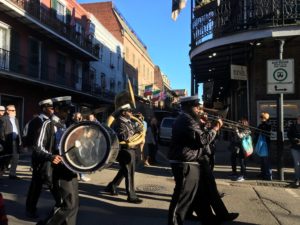 PS: The music in New Orleans was out of this world!