A big aspect of the House Poetics project is trying to figure out the extent to which the spatial blueprint we discover archaeologically can be correlated to the actual social patterning of kinship (or house) relations.
A really interesting option emerged in the course of a parallel (and related) approach to assemblages (of the Deleuzian kind), where I looked at bread making as a chaîne opératoire linked with pottery making 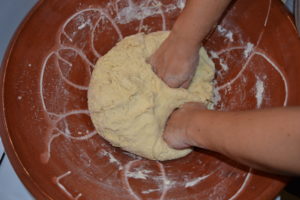 (a collaboration with Despina Catapoti, appearing in print during 2020 in the Journal of Material Culture).
In the process of that I did some ethnographic work mapping the distribution of bread ovens in a mountainous village in Crete, linking them to local genealogies as recounted to me by villagers and members of my own family. A key finding was that while households would operate through a ‘nuclear family’ scheme, with separate residence and ownership of land and resources, in practice and for certain routine activities, such as bread making, they would regularly pool resources and use shared facilities, like the bread ovens. Not every nuclear family household would own a bread oven, but every nuclear family household baked with the same regularity (approximately every 2-3 weeks). Different families would have access to a shared bread oven, on the basis of extended kinship, but many families made use of bread ovens on the basis of neighbouring residence (although in a village of such a small size, kinship ties among all villagers were pervasive, and therefore, even though people might have shared bread ovens with non-immediate relatives, they still probably had some form blood or kin-through-marriage relation).
 The most interesting finding of this comparison, was that while ownership of resources was distinct, i.e. each family had its own house, land and other moveable property, access to facilities like bread ovens [necessary for the daily subsistence of each family] was shared, and what’s even more striking, shared smoothly, without conflict. An informal ‘booking’ system was at place, where each family would ‘book’ baking time each week, but more common was the pooling together of resources into large-scale bake offs: so, each family would bring their own portion of grain and they would also get the equivalent in baked goods, but they would contribute fuel and labour co-operatively so that the bread required by each different family in several weeks would be made in one baking event. This kind of event did not have the indexical features of what we often like to call ‘feasting’ in the archaeological record (although the precise meaning and material correlates of feasting are continuously re-assessed in recent scholarship) as it was more mundane and regular, however, it involved fairly large numbers of people, as most of the ‘nuclear’ families involved would comprise at least between 5 and 8 members, who would all participate in various ways and would need to be fed during the process.
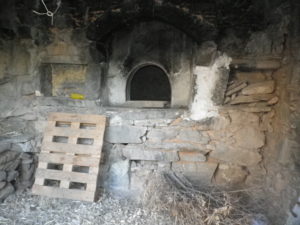 The other aspect that was of interest was the spatial arrangement of these ovens in distinct neighbourhoods around the village; I was able to map at least 5 surviving structures, whereas I also collected information about 5-6 others that were no longer in existence. This set of data requires a lot more analysis, but from a first look, it seems that oven structures were shared both within the broader kin group which did not always reside in close proximity, and amongst neighbours, who resided close to one another without sharing kin ties. The sharing of resources like the bread ovens was thus regulated both by functional necessity, i.e. needing to bake regularly, and convenience, i.e. needing a facility in relatively easy access. At the same time though, ‘patterns of sharing’ were evident, where families would have their ‘regular’ oven, whether access to that was provided through kin membership, or through neighbourhood residence; so family X would regularly bake in Oven A, even though they were not immediate blood relatives; while Family Y would only bake at their maternal bread Oven B, even though it was a long way from their actual house.
 The warmth of affective ties emerging through this sharing was striking in all the oral testimonies collected. This kind of emotional connection is not easily detected ‘in the ground’, from the material residue we deal with archaeologically, but it can be grasped through the long-term engagement with such practices, and this, archaeology can ‘recover’ well.
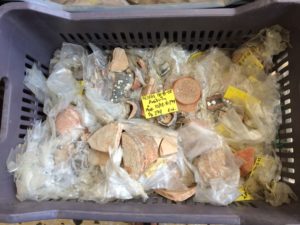 mice (they’ve eaten all the plastic bags, which meant re-bagging finds, which led to unexpected discoveries !) have actually led me to find stuff that I could not locate with the usual methods of cross-referencing catalogues and box labels.