
Why am I finding the same thing in different materials deposited/consumed in the same contexts?
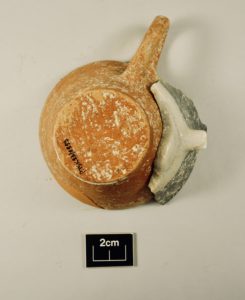 A real advantage of the House Poetics project is that it has allowed me to work across conventional categories and typologies. There are obviously practical reasons for why we divide archaeological finds into categories based on material and form, it is impossible to study everything all at once. As it is equally impossible for one person to have specialised knowledge of every type of artefact or ecofact that emerges from a field project. But there are a few problems from this system: a) our definitions of what -goes-with-what may not represent ancient categorisations (a lot of ink continues to be spilt about this; rightly so, I think); and b) this over-compartmentalisation of our material means that we are regularly missing connections that can only be grasped by looking across these categories.
This happened at the beginning of the project when looking at both pottery and stone vase assemblages, I encountered one example of a bird’s nest bowl made of clay. As this had been deposited in a mortuary context, it was perhaps easy to think of it as a one-off, a difficult to explain case of skeuomorphism as this shape is considered to be a predominantly lithic type, invented for and 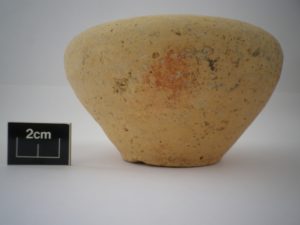 only encountered on stone. But to my surprise and delight, the more I looked the more examples kept cropping up, and not just of this rather specialised shape, but of other more mundane forms. Such interconnections are not easily explained by function (for example, a stone vase cooking pot is incredibly heavy, and more so when full), neither by trickster value (i.e. they are not meant to be substitutes of more ‘precious’ stuff) as they are consumed alongside each other. I continue to muse on these questions, but I am really warming to the idea that these have been created as sets. Especially since there’s also a range of small lids, of similar dimensions that could fit either stone, or ceramic vases of a range of shapes. This would make for such a colourful and versatile assemblage, created entirely at the interstices of what we consider different categories.
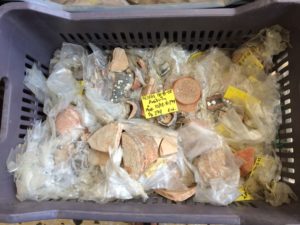 mice (they’ve eaten all the plastic bags, which meant re-bagging finds, which led to unexpected discoveries !) have actually led me to find stuff that I could not locate with the usual methods of cross-referencing catalogues and box labels.